If you own a listed building, or are considering buying one, the Historic England List description is a useful starting point. Understanding the shorthand used makes it easier to follow the building’s history and recognise where further advice may be needed.
For quick reference: ‘C18’ means ‘18th century’, ‘c.’ means ‘circa’ – or approximately, and ‘GV’ means ‘group value’. These small details in a Historic England List description can help you understand the current understanding of a building’s age and its relationship with neighbouring properties.
A small abbreviation with a century of difference
A client recently contacted me to check the age of their listed property while arranging buildings insurance. My research for their heritage statement had supported the list description’s date of ‘mid-C18’. They had understood this to mean the 1800s.
In fact, it means the middle of the 18th century, around the middle of the 1700s. Their home was roughly a century older than they had thought.
It was a useful reminder that the shorthand I read regularly in my work is not always familiar to the people who live in these buildings. A few letters can make a considerable difference to how someone understands their home.
Common abbreviations at a glance
| Abbreviation | Meaning |
| C16 | 16th century, 1501–1600 |
| C17 | 17th century, 1601–1700 |
| C18 | 18th century, 1701–1800 |
| C19 | 19th century, 1801–1900 |
| C20 | 20th century, 1901–2000 |
| c. or circa | Approximately, usually placed before a year |
| GV | Group value |
| NGR | National Grid Reference, used to locate the building |
Understanding C18 and other building dates
In this context, the capital ‘C’ stands for ‘century’. C18 therefore means the 18th century. Strictly, that century runs from 1701 to 1800, although ‘the 1700s’ is a useful everyday way to remember it.
You may also see ‘early’, ‘mid’ or ‘late’ before the abbreviation. These indicate an approximate part of the century. ‘Mid-C18’ suggests around the middle of the 1700s, rather than a precise construction date or a fixed range of years, often taken to mean from between 1725-1775, for example.
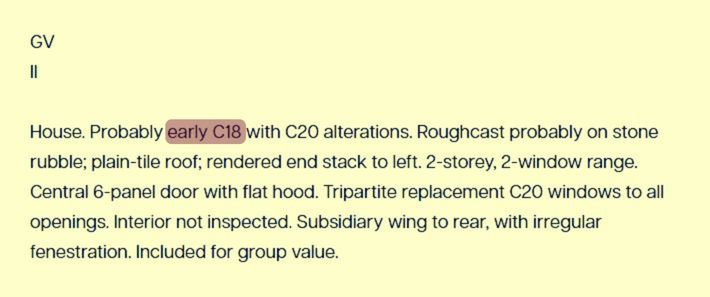
A lower-case ‘c.’ before a year has a different meaning: circa, or approximately. For example, c.1750 means ‘around 1750’.
Read the surrounding words carefully. A description such as ‘C17 house with C19 alterations’ identifies more than one phase of work. An old timber frame may survive behind a later brick front, so the date of the façade may differ from the age of the building beneath it.
If you need to give a construction date to an insurer, explain any uncertainty and ask how they would like an approximate date recorded. A list description can provide useful evidence, but it may need to be checked against further research as I have found some List descriptions to be a century out!
Understanding ‘Grade II’, ‘Grade II*’ and ‘Grade I’
Listed buildings in England are one of three grades, indicated by Roman numerals. Historic England describes them as follows:
| Grade | Meaning |
| II, (pronounced ‘Grade two’) | Special interest |
| II*, (pronounced ‘Grade two star’) | Particularly important buildings of more than special interest |
| I, (pronounced ‘Grade one’) | Exceptional interest |
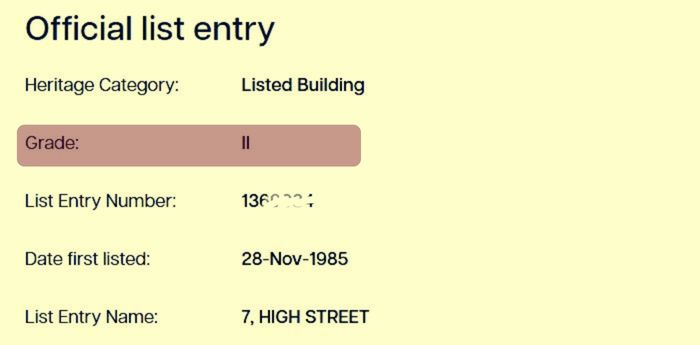
Grade II is the most common with almost 92% of all listed buildings falling into this category. All three grades carry statutory protection, and internal changes requires consent as well as external alterations. [1]
What does ‘group value’ mean?
‘GV’ stands for ‘group value’. It highlights the contribution a building makes as part of a group, through its architectural or historic relationship with other buildings or structures. [2]
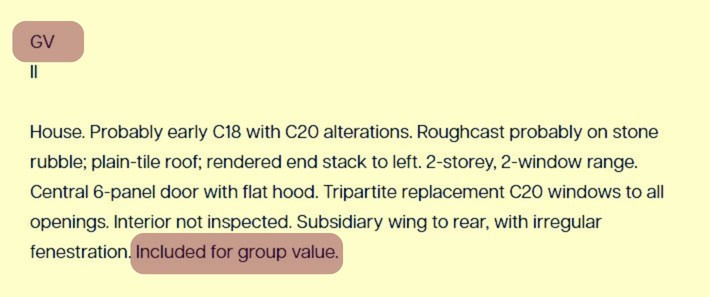
This might be a terrace, a collection of farm buildings or buildings around a historic square. Their relationship helps explain the interest of the individual property.
‘GV’ is not a separate listing grade and does not automatically bring neighbouring properties into the same listing. For an owner, it is a helpful prompt to look beyond the property boundary and consider how proposed changes might affect the wider group.
What is the difference between the building’s age and the date it was first listed?
The ‘Date first listed’ records when the entry was added to the statutory List. It does not tell you when the building was constructed. A Georgian house might, for example, have been listed in the 1980s. [3]
This date helps when checking the history of alterations. Works carried out before listing did not require listed building consent at that time, although other permissions may have been needed. Once listed, demolition and alterations or extensions affecting the building’s special architectural or historic character require listed building consent. [4]
When buying a listed property, ask your solicitor to investigate the relevant consents for previous work. The presence of a modern window, extension or internal layout does not establish whether it was authorised.
Reading beyond the description
List descriptions vary considerably. Older entries are often brief and were written primarily to identify the building. They are not a complete inventory of everything of interest.
Unless an entry contains an explicit legal exclusion, listing generally covers the whole building, including its interior. A feature’s absence from the description does not mean it can be altered without consent. [3]
I treat the description as the beginning of understanding a building. Research and a careful inspection can reveal how it developed, which features matter and how thoughtful change can support its future use.
If you would like help understanding your listed building or planning changes, I can advise through Heritage Revival. For more practical guidance and observations from historic places, subscribe to my monthly newsletter, Heritage Revival Notes.